實用的原則是:任何你不會放進公司共用文件的東西,就別貼進公開的聊天機器人。真實的客戶名稱、合約編號、跟特定人名綁在一起的薪資、任何在保密協議(NDA)下的內容——貼之前先換成佔位符,等 AI 寫好草稿後,自己再把真實細節填回去。下面的提示詞用 {{variable}} 佔位符,一部分是為了重複使用,一部分也是為了讓你能把敏感資訊完全留在對話之外。
如果公司給你的是商業版或企業版 AI 帳號,那些通常不會拿你的輸入來訓練——在決定什麼能放心貼之前,值得先確認一下。
You're writing a follow-up email. I emailed {{recipient}} {{days_ago}} days ago about {{topic}} and haven't heard back. Write a short, friendly follow-up that:
- briefly reminds them what I asked
- adds one useful detail or reason to reply now: {{new_detail}}
- gives them an easy out (e.g. "happy to circle back later if now's not the time")
Keep it under 90 words, warm but not pushy. No "just checking in."
You're writing a cold outreach email. About me: {{my_role_and_company}}. I'm reaching out to {{recipient_role}} at {{their_company}}. Their likely pain point: {{pain_point}}. What I offer: {{value_in_one_line}}.
Write a cold email under 100 words that opens with something specific to them (not about me), names the pain point, gives one clear benefit, and ends with one low-pressure ask: {{soft_ask}}. No buzzwords.
Write a polite, brief email asking {{recipient}} for {{the_request}}. Context: {{why}}. The original deadline was {{original_deadline}}; I'd like to move it to {{proposed_new_deadline}}.
State the ask clearly, give one honest reason without over-explaining or making excuses, and propose the specific new date. Under 100 words, respectful and confident.
Write a polite email declining {{what_im_declining}} from {{recipient}}. Our relationship: {{relationship}}.
Structure: open by acknowledging or thanking them, decline clearly in one sentence, give a short honest reason (1 sentence), offer one realistic alternative: {{alternative}}, and close warmly. Keep it under 110 words. Kind but unambiguous — no waffling.
Write a professional apology email to {{recipient}} for {{what_went_wrong}}. The impact on them: {{impact}}. How I'm fixing it: {{fix}}.
Include: a clear acknowledgment, genuine empathy for the impact, ownership (no excuses or blame), the concrete fix and timeline, and a brief commitment it won't recur. Sincere and direct, under 130 words. Don't grovel.
Write a calm, empathetic reply to an upset customer. Their complaint: {{complaint}}. What we can do: {{solution}}. Who follows up and when: {{next_step}}.
Open by acknowledging their frustration, apologize for the specific problem (not a generic "sorry for any inconvenience"), lay out the solution in plain language, and state the next step with a name and timeframe. No jargon, no defensiveness. Under 140 words.
Write a salary negotiation email responding to an offer. Role: {{role}}. Offer: {{current_offer}}. My target: {{target_number}}, based on {{market_data_or_reason}}. One line on the value I bring: {{value}}.
Thank them and show genuine enthusiasm for the role, state my counter backed by the reasoning, keep the tone collaborative ("I'm excited to make this work"), and invite a conversation. Under 180 words, confident and warm — not demanding.
Write a short email requesting a meeting with {{recipient}} about {{purpose}}. Why it matters to them: {{benefit}}. My availability: {{2_or_3_specific_times}}.
Keep it 50–125 words. State the purpose and the benefit to them, offer the 2–3 specific time slots, and end with one clear ask to confirm. Suggest a 2–4 word subject line too.
9. 給利害關係人寄進度更新。 忙碌的利害關係人只會掃個幾秒。先給一個簡單的狀態訊號,再講重點。
Write a concise project status update email to {{stakeholders}} for {{project}}. Overall status: {{green_amber_red}}. Key wins: {{wins}}. Current blockers and how I'm handling them: {{blockers_and_plan}}. Next steps with dates: {{next_steps}}.
Start with a one-line status snapshot, then short bulleted sections for wins, risks, and next steps. Scannable in 10 seconds. No fluff.
Write a short, genuine thank-you email to {{recipient}} for {{what_they_did}}. The specific impact it had: {{impact}}.
Name exactly what they did and why it mattered — no generic "thanks for everything." Warm, specific, under 80 words. Sound like a real person, not a greeting card.
11. 重新聯絡舊識。 隔了很久才重新聯絡時,把第一封信純粹放在關係上——不要夾帶任何請求。
Write a warm, low-key email reconnecting with {{contact}}, who I haven't spoken to in {{time_gap}}. How we know each other: {{shared_history}}. Something genuine I can mention: {{personal_note}}.
Acknowledge the gap honestly without over-apologizing, reference our shared history, and keep it purely about reconnecting — no favor or pitch in this one. Under 80 words, casual and genuine.
Write an email to {{manager}} requesting {{a_raise_or_promotion}}. My recent wins, with numbers: {{quantified_achievements}}. What I'm asking for: {{specific_ask, e.g. a 7% raise or Senior title}}.
Remind them of the concrete results, make the specific ask, and request a short meeting to discuss. Confident but respectful, under 160 words. Lead with value, not need.
13. 回覆工作錄取通知。 保持簡短、確認細節,並回答對方問的每一個問題。
Write a {{accept_or_respond}} email for a job offer from {{company}} for the {{role}} position. Details to confirm: {{title, start_date, salary, anything_else}}. Any questions I still have: {{questions}}.
Keep it short and professional, express genuine enthusiasm, confirm the key details, and answer or ask anything outstanding. No emojis or slang.
14. 提離職。 離職信主要就是處理流程細節:你的職位、最後工作日、感謝,以及主動提出協助交接。
Write a professional resignation email to {{manager}}. My role: {{position}}. Last working day: {{last_day}}. I want to keep it positive and brief.
State that I'm resigning and my last day, express genuine gratitude for the experience, and offer to help with the transition. Keep my reason for leaving private. Warm and gracious, under 120 words.
修好任何草稿
15. 萬用改寫。 這是你會用最多次的一個。Email 怎麼寫出來都行——亂、太長、太直白——然後讓 AI 幫你潤飾。
Rewrite the email below to be clearer and more professional while keeping my original meaning and intent. Make it shorter, cut filler and hedging, fix grammar and flow, and keep a {{tone, e.g. warm and direct}} tone. Don't add information I didn't include.

Email:
{{paste_your_draft}}
AI 開箱即用時,寫出來的口吻很容易被認出來——而且大家越來越會看穿了。解法是把你的口吻交給 AI 去模仿。最有效的一招:貼幾封你自己以前寫過的 Email 進去。
Here are two emails I've written before. Study my writing style — sentence length, level of formality, how I open and close, the words I use.

Sample 1: {{paste_email_1}}
Sample 2: {{paste_email_2}}

Now write an email about {{topic}} to {{recipient}} in that same voice. Match how I actually write, not a generic professional tone.
就算這樣,還是要留意那些一看就「這是機器人寫的」的字眼和習慣。在你修稿時把它們拿掉,或者一開始就叫 AI 避開:
「希望這封信能順利送達,並祝您一切安好」——最常被點名的 AI 開場白。直接講你為什麼寫信就好。
浮誇的字眼,像是深入探討、賦能、強健、無縫接軌、顛覆性的。
破折號用過頭,以及「不只是 X,更是 Y」這種句型。
凡事都湊成三個——三個形容詞、三個項目、三個例子,一直重複。
籠統的開場白,用了對方的名字,卻講不出任何關於他的具體內容。
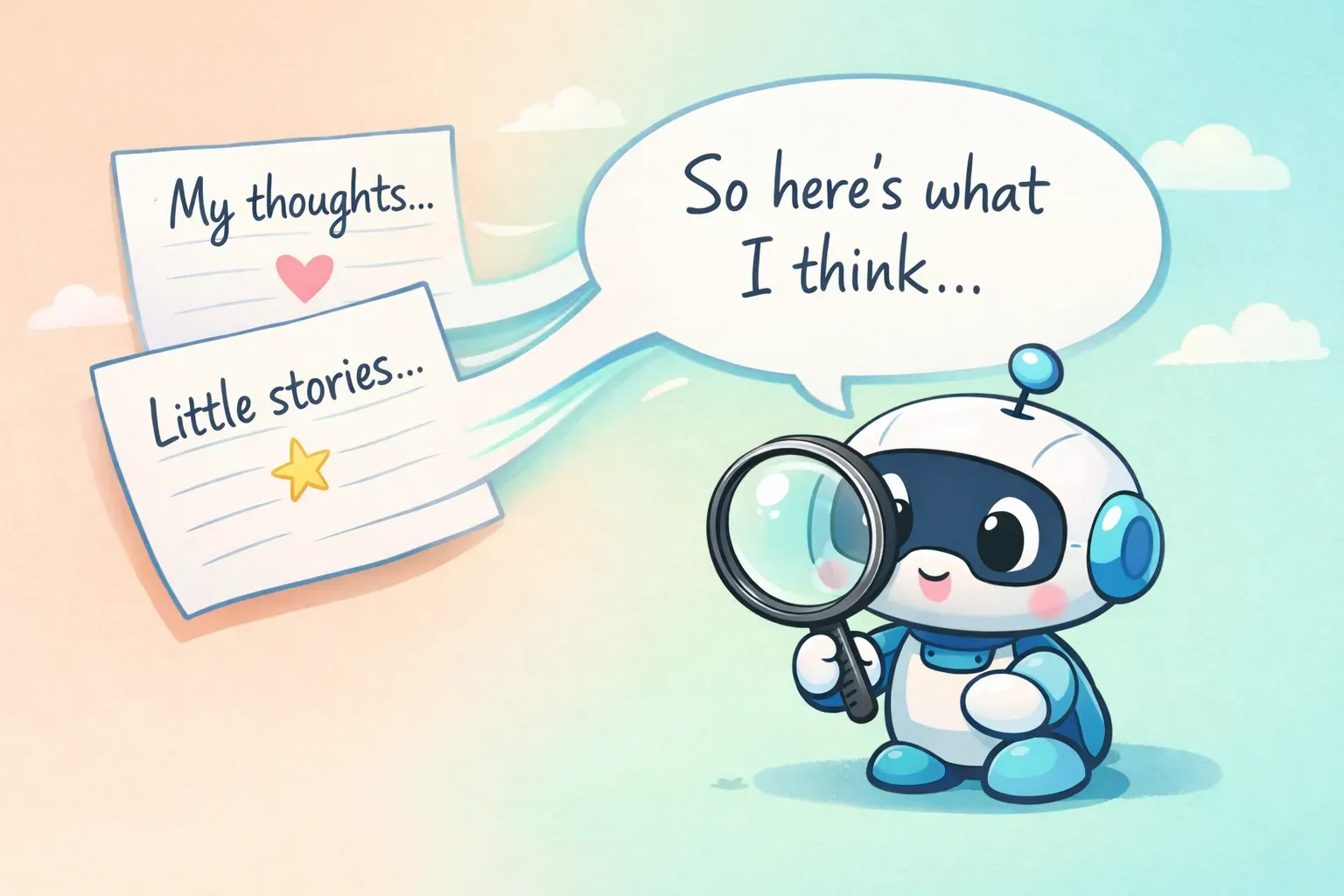
兩張手寫便條匯流進同一個對話框,一個小機器人正在讀它們,象徵教 AI 學會你個人的寫作口吻
語氣也是可以調的——只要講得夠具體。與其說「寫得不要那麼正式」,不如試試「寫得溫暖一點、用短一點的句子,並拿掉所有公司行話」。想在這方面深入一點,我們寫過一整篇關於 如何寫出像你的 AI 提示詞 的指南。
工作 Email 到底該不該用 AI?
這裡值得老實說。Euronews 報導的一份 2025 年研究發現,當主管很依賴 AI 來寫 Email 時,員工會覺得他們比較不真誠——只有 40% 認為他們真誠,相較之下,少用或不用 AI 的主管則有 83%。大家對輕度潤飾沒意見;他們反感的,是那種明顯外包出去、又屬於關係性質的訊息。
重點不是「別用 AI」,而是 AI 是寫草稿的助手,不是那些承載真實情感的訊息的代筆。例行的東西儘管用——排程、進度更新、禮貌的婉拒。至於發自內心的感謝、或敏感的對話,就讓它打草稿,然後把它真正改成你的。
而且不管怎樣,寄出前每一封信都要讀過。AI 可能會憑空編出細節、誤判語氣,或一臉自信地講出根本不對的事。把話說清楚:用 AI 把信寫得更好,不算作弊——根據微軟的研究,已經有 75% 的知識工作者在工作上用 AI 了。界線在於有沒有造假,而不在工具本身。你仍然是作者;AI 只是幫了草稿一把。