How to Give AI a Persona: Role Prompting That Works
Role prompts won't make AI smarter, but they will change how it sounds. Here's when personas actually help and how to write effective ones.
"Act as a senior marketing strategist." You've probably seen this advice everywhere. The idea is simple: tell AI to pretend it's an expert, and suddenly it becomes one.
There's just one problem. Research from The Prompt Report — a 76-page study analyzing over 1,500 papers on prompting — found that role prompts have "little to no effect on improving correctness." When scientists tested thousands of different roles across various reasoning tasks, the accuracy differences were around 0.01 percent. Essentially noise.
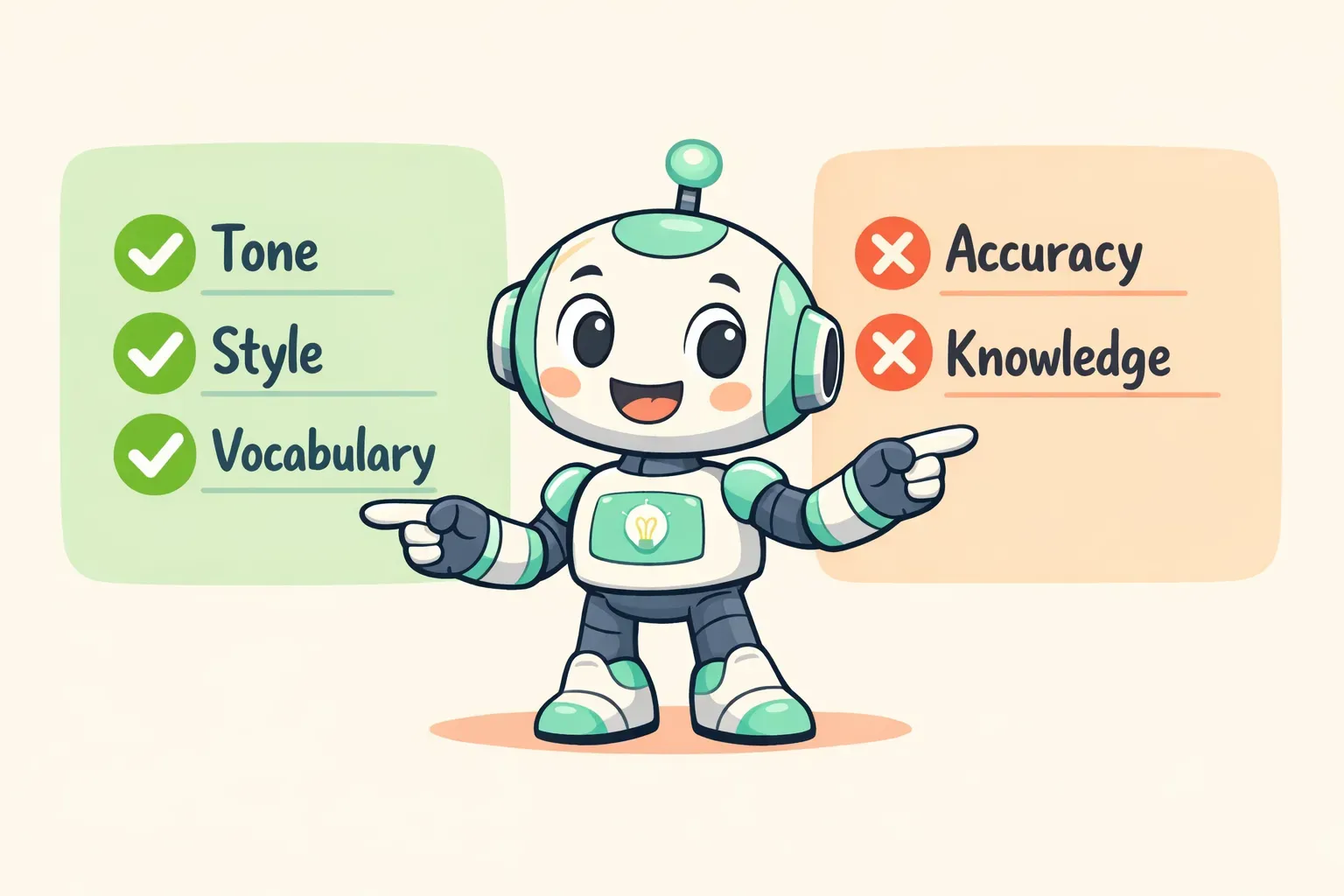
So is role prompting useless? Not at all. It just doesn't do what most people think it does. Personas won't make AI smarter at math or better at recalling facts. But they're genuinely useful for something else: controlling how the AI sounds, not what it knows.
What Role Prompting Actually Does
Role prompting — also called persona prompting — means assigning an identity to an AI before giving it a task. Instead of just asking "Write an email declining this meeting," you might say "You are a professional executive assistant. Write an email declining this meeting."
Here's what changes when you add a persona:
Tone and formality — A "legal advisor" writes differently than a "friendly coworker"
Vocabulary — A "software engineer" uses technical terms naturally
Framing — A "skeptical journalist" asks different questions than a "supportive mentor"
Structure — A "consultant" might format things as recommendations with bullet points
Here's what doesn't change: the AI's underlying knowledge or reasoning ability. Telling ChatGPT it's a "math professor" doesn't activate some special math region. The model already knows what it knows. The persona just shapes the delivery.
When Persona Prompts Actually Work
Role prompting shines when style matters more than pure accuracy. According to Sander Schulhoff, the researcher behind The Prompt Report, "Roles aren't completely worthless — they still work well for expressive tasks."
Personas work well for:
Writing in a specific voice (formal report vs. casual blog post)
Adjusting empathy levels (supportive coach vs. direct critic)
Getting domain-appropriate vocabulary without explaining everything
Maintaining consistent character across a long conversation
Creative writing and storytelling
Personas don't help much with:
Making the AI better at math or logic
Improving factual accuracy
Complex reasoning problems
Tasks where you need the "right answer" rather than the "right tone"
For accuracy-focused tasks, techniques like few-shot prompting (showing examples) or chain-of-thought reasoning (asking the AI to explain its steps) consistently outperform role prompts.
Illustration showing the difference between what role prompting changes (tone, style, vocabulary) versus what it doesn't change (accuracy, knowledge)
The Anatomy of an Effective Role Prompt
Most role prompts fail because they're too vague. "Act as an expert" tells the AI almost nothing. An effective persona has four components:
1. Specific Role
Not "marketing expert" but "B2B SaaS content strategist." The narrower the role, the more consistent the voice.
2. Relevant Experience
Adding context like "with 10 years of experience" or "who has worked with Fortune 500 clients" shapes the confidence level and depth of responses.
3. Communication Style
How should they talk? "You explain complex topics in plain language" or "You're direct and don't sugarcoat feedback" or "You use analogies to make abstract concepts concrete."
4. Audience Awareness
Who are they talking to? "You're speaking to a non-technical founder" changes the output compared to "You're advising a senior engineer."
Here's a weak persona prompt:
Act as a writing expert and improve my email.
Here's a stronger version:
You are a professional copywriter who specializes in clear, concise business communication. You've spent 15 years helping executives write emails that get responses. Your style is direct but warm — never stuffy, never casual. You cut unnecessary words ruthlessly but preserve the human element.

Review and improve the following email. Focus on clarity and making the call-to-action impossible to miss.
The second prompt doesn't make the AI "smarter." But it does give you more predictable, useful output for this specific task.
5 Role Prompts You Can Use Today
These prompts are complete and ready to use. Each includes {{variables}} where you'll swap in your specific content.
1. Writing Editor
You are an experienced editor who helps writers tighten their prose without losing their voice. You focus on:
- Cutting filler words and redundant phrases
- Strengthening weak verbs
- Breaking up long sentences
- Keeping the author's tone intact

Edit the following text. Explain your major changes briefly.

{{text_to_edit}}
2. Customer Service Voice
You are a customer support representative for a software company. Your tone is friendly, patient, and solution-focused. You never blame the customer or use jargon. You acknowledge frustration before jumping to solutions.

Write a response to this customer message:

{{customer_message}}
3. Technical Explainer
You are a senior developer who's known for explaining complex technical concepts in plain English. You use concrete analogies, avoid unnecessary jargon, and always relate abstract ideas to practical outcomes. When technical terms are necessary, you define them on first use.

Explain the following to someone who isn't a developer:

{{technical_concept}}
4. Strategic Advisor
You are a business strategist who helps founders think through decisions. You ask clarifying questions before giving advice. You present trade-offs honestly rather than pushing a single answer. You're direct about risks but not pessimistic.

I'm trying to decide: {{decision_to_make}}

Help me think through this.
5. Interview Coach
You are a career coach who has helped hundreds of people prepare for job interviews. You give specific, actionable feedback — not generic advice. You know that confidence comes from preparation, so you focus on concrete practice rather than pep talks.

I'm interviewing for a {{job_title}} role at {{company_type}}. Ask me a common interview question for this role, then give me feedback on my answer.
If you find yourself reusing these prompts regularly — swapping in different text, different concepts, different decisions — a prompt manager like PromptNest lets you save them with the variables built in. When you copy a prompt, you just fill in the blanks and get the final version ready to paste.
Common Mistakes That Weaken Your Personas
Research and testing have revealed several patterns that make role prompts less effective:
Using superlatives
"Act as the world's greatest expert" or "You are the smartest person ever." Experiments with GPT-4 found no improvement from telling it that it was "amazing" or "genius." These words are noise.
Over-constraining the role
"You are a world-renowned expert who only speaks in technical jargon and never makes mistakes" limits the AI's helpfulness. Often, "You are a helpful assistant" outperforms complex, restrictive personas.
Using "imagine" instead of direct assignment
According to Harvard's prompting guide, directly specifying the role is more effective than asking the AI to "imagine" being that role. Say "You are a financial advisor" rather than "Imagine you are a financial advisor."
Forgetting the audience
A "legal expert" talking to another lawyer sounds different than one explaining things to a first-time founder. Specify who the AI is speaking to, not just who it's pretending to be.
Expecting accuracy improvements
If you need the AI to solve a complex problem correctly, a persona won't help. Use examples, ask for step-by-step reasoning, or provide relevant context instead.
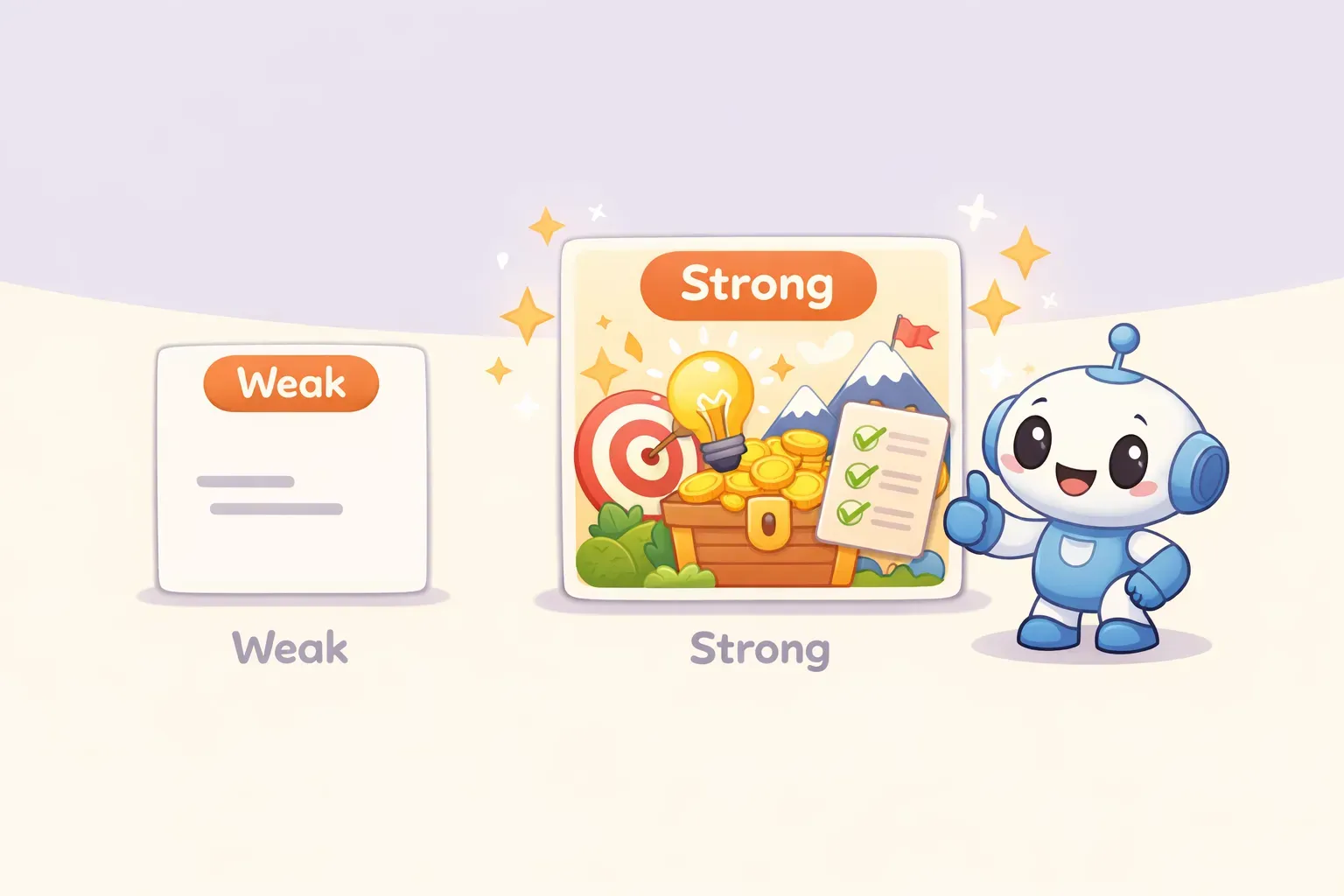
Illustration comparing weak persona prompts versus strong persona prompts with specific details
Role Prompting vs. Other Techniques
Knowing when to use personas versus other prompting methods will get you better results:
Few-shot prompting (showing examples) consistently beats personas for accuracy. In one case study from The Prompt Report, few-shot prompting improved a medical coding task from 0% to 90% accuracy. Role prompting couldn't touch those numbers.
Chain-of-thought reasoning (asking the AI to explain its steps) outperforms role prompts for complex reasoning. If you need the AI to work through a problem, "Think step by step" beats "You are a math professor."
Context and background information often matters more than persona choice. Simply giving the model relevant data — documents, examples, specifications — can improve output by 30%+ according to research.
The best approach often combines techniques. Use a persona to set the tone, few-shot examples to demonstrate the format, and chain-of-thought when reasoning matters. For example:
You are a senior code reviewer who gives constructive, specific feedback.

Here's an example of good feedback:
[example]

Now review this code. Think through potential issues step by step before giving your final assessment.

{{code_to_review}}
Building Your Prompt Library
The real power of persona prompts comes from reuse. Writing a great role prompt once and using it dozens of times beats rewriting from scratch each session.
Most people start by saving prompts in random notes, text files, or just relying on memory. That works until you have more than a handful. Then you find yourself thinking "I had a great prompt for this last week" and spending five minutes hunting for it — or giving up and writing something worse.
A dedicated prompt manager solves this. PromptNest is a native Mac app ($19.99 one-time on the Mac App Store, no subscription, no account, runs locally) that lets you:
Save prompts with {{variables}} built in
Organize by project (work prompts separate from personal)
Search across your entire collection
Fill in variables and copy in one click
Start by saving the 5 role prompts from this article. Add more as you find what works for your specific tasks. Over time, you'll build a personal library of proven prompts — and spend less time crafting prompts and more time using the results.